
.jpeg)
AI-Enabled Resilience in Turbulent Markets: Evidence from U.S. and Korean Supply Chains
1 Unknown Institution
Abstract
Global supply chains are increasingly vulnerable to turbulence caused by changing customer demands, rapid technological advancements, and unpredictable disruptions. Drawing on the dynamic capabilities view and organizational information processing theory, this study examines how market dynamism influences the adoption of artificial intelligence and supply chain resilience, with a particular focus on cross-national differences between the United States and Korea. Using survey data from 297 firms and employing partial least squares structural equation modeling with multigroup analysis, the study highlights the role of resilience in translating environmental turbulence and technological adoption into performance outcomes. Overall, market dynamism positively impacts AI adoption and resilience, and AI adoption significantly enhances resilience. Multigroup analysis reveals notable contextual differences: U.S. firms respond more directly to market dynamism by adopting AI and improving their resilience, whereas Korean firms rely more heavily on AI adoption to develop resilience after implementing the technology. A moderation analysis further reveals that market dynamism strengthens the effect of AI adoption on firm performance, underscoring the contextual nature of AI-enabled resilience. The findings refine the dynamic capabilities view by showing that capability deployment effectiveness is context-dependent rather than universal, and they extend organizational information processing theory by conceptualizing AI as an adaptive mechanism shaped by institutional and technological conditions.
Ⅰ. Introduction
Global supply networks are facing unprecedented turbulence, driven by rapid technological advancements, shifting consumer preferences, and frequent disruptions, including geopolitical disputes and health crises. The COVID-19 pandemic, for example, exposed how swiftly supply chains can fracture when organizations lack the technological foresight and organizational agility to detect and adapt to shocks (Belhadi et al., 2021). These challenges highlight the critical importance for companies to not only bolster their supply chain resilience (SCR) but also to harness emerging technologies as key strategic tools to enhance flexibility and increase transparency (Cimino et al., 2025).
While the potential of AI to augment operational decision-making is well recognized, its adoption within supply chains remains uneven and context-dependent. In the United States, for example, fewer than 6% of firms had adopted AI by the early 2020s, with adoption concentrated among large organizations and those already investing in complementary technologies (Mc Elheran, 2024). In contrast, firms in emerging markets often adopt AI to manage external pressures such as unstable supplier relationships and fluctuating customer demands (Cimino, 2025). These differences raise important questions about whether the drivers and performance outcomes of AI adoption are universal or contingent on institutional and market conditions.
Previous research provides valuable insights into the role of big data analytics and AI capabilities in enhancing agility and performance (Dubey et al., 2020; Wamba et al., 2020). These studies also demonstrate that supply chain resilience facilitates the relationship between environmental dynamism and financial outcomes (Yu et al., 2019). However, several gaps in the literature remain. First, the relationship between market dynamism, AI adoption, and SCR has not been empirically tested across diverse national contexts (Attah et al., 2024). Second, while mediation mechanisms have been theorized (e.g., resilience as a dynamic capability), few studies combine mediation analysis with multigroup analysis to compare how these mechanisms operate across different institutional settings directly (Modgil et al., 2022). Finally, existing research tends to examine AI adoption in isolation (Dubey et al., 2020), failing to fully capture how it interacts with dynamic environments to shape firm performance.
While prior studies have applied either the dynamic capabilities view or organizational information processing theory independently, little research has explored the intersection of digital technologies with these theories (Belhadi et al., 2021). This research combines both perspectives to develop a model where AI adoption serves as a link between capability reconfiguration and information processing, illustrating how digitalization helps firms turn environmental turbulence into resilience and improved performance. Using partial least squares structural equation modeling (PLS-SEM) and multigroup analysis (MGA), the study explores how market dynamism impacts AI adoption, supply chain resilience, and firm performance, with particular attention to potential differences between Korean and U.S. companies.
This study advances theory in three ways. First, the researchers conceptualize AI adoption as a hybrid capability that simultaneously performs sensing, seizing, and information-processing functions. This dual characterization deepens the dynamic capabilities view by showing that digital technologies not only reconfigure resources but also supply the real-time information necessary for adaptation. Second, by comparing U.S. and Korean firms, the research demonstrates that dynamic capabilities are not universally effective; instead, their performance effects depend on institutional conditions such as digital maturity, managerial autonomy, and uncertainty avoidance. Third, the study identifies supply chain resilience as a mechanism that converts both market turbulence and technological adoption into performance outcomes, revealing a link in the dynamic capabilities view hierarchy of capabilities.
II. Literature Review
2.1 Theoretical Underpinnings
This study is anchored in two complementary perspectives: the dynamic capabilities view (DCV) and organizational information processing theory (OIPT). Together, these frameworks explain how firms adopt AI technologies and build supply chain resilience in response to turbulent environments.
The dynamic capabilities framework (Teece et al., 1997) emphasizes that, in volatile markets, firms must develop capabilities to sense environmental changes, seize emerging opportunities, and reconfigure resources to maintain competitiveness. AI adoption enables firms to sense shifts in customer demand, supplier performance, and market dynamics through predictive analytics and real-time monitoring (Dubey et al., 2020; Belhadi et al., 2021). SCR extends this logic by acting as a higher-order dynamic capability. It enables firms to integrate technological, relational, and organizational resources to withstand and recover from disruptions, thereby safeguarding long-term performance (Yu et al., 2019). From a DCV perspective, AI adoption strengthens resilience by providing tools that enlarge agility, visibility, and reconfigurability in supply chain operations.
OIPT (Galbraith, 1973) suggests that organizations must match their information-processing capacity to the level of uncertainty and complexity in their environment. Market dynamism is marked by rapid technological innovations, changing customer demands, and competitive turbulence (Jaworski & Kohli, 1993), which present significant information-processing challenges. Firms must absorb and analyze large volumes of dynamic, rapidly changing data to make informed, timely decisions. AI technologies enhance organizational information-processing capacity by enabling predictive modeling, anomaly detection, and real-time decision support (Attah et al., 2024). By increasing the scope and speed of information handling, AI helps firms synchronize their decision-making with environmental uncertainty, ultimately supporting resilience.
Integrating DCV and OIPT reveals that AI adoption occupies a unique boundary position between capability deployment and information processing. While DCV emphasizes the strategic routines that enable firms to sense and reconfigure resources, OIPT explains how organizations absorb and analyze environmental data to support those routines. AI technologies operationalize this linkage by transforming environmental signals into actionable insights, thereby acting as the micro-foundational mechanism through which dynamic capabilities function under turbulence. Additionally, DCV explains why firms require new capabilities to adapt to environmental turbulence, while OIPT clarifies how AI adoption intensifies the capacity to process information and respond effectively to uncertainty. This dual-theoretical foundation positions AI adoption as both a dynamic capability and an information-processing mechanism, making it central to the development of resilient supply chains and increased firm performance. In this way, OIPT provides the micro-foundational logic for DCV: information-processing routines form the operational layer through which dynamic capabilities are enacted. AI functions as the connective mechanism. Its analytics translate sensing and seizing (DCV) into timely interpretation and action (OIPT), thereby linking environmental signals to resource reconfiguration and performance outcomes.
2.2 Hypotheses Development
2.2.1 Market Dynamism
Market dynamism refers to the degree of volatility in customer preferences, competitive actions, and technological changes (Jaworski & Kohli, 1993). In dynamic markets, conditions shift rapidly and unpredictably, forcing firms to make decisions under heightened uncertainty. This turbulence intensifies information-processing demands (Galbraith, 1973), and firms must develop stronger sensing, seizing, and reconfiguring capabilities to remain competitive (Teece et al., 1997).
From an OIPT perspective, firms in dynamic environments face a mismatch between the information required for effective decision-making and their internal processing capacity. This disparity compels organizations to adopt advanced technologies that expand data-processing capabilities and reduce uncertainty (Wamba et al., 2020). AI solutions, in particular, help firms address dynamism by providing real-time market insights and predictive analytics, thereby reinforcing responsiveness (Attah et al., 2024). For example, Cimino (2025) demonstrates that startups operating in volatile industries use AI-enabled analytics to maintain competitiveness, directly linking environmental turbulence to AI adoption. Thus, firms exposed to high levels of market dynamism are more likely to integrate AI technologies as a strategic response mechanism.
Dynamic markets also pose a threat to supply chain continuity, as unstable demand patterns, supplier disruptions, and rapid technological shifts undermine established routines. Research demonstrates that turbulence stimulates resilience-building, as firms recognize the need for flexible sourcing, collaboration, and adaptive logistics (Belhadi et al., 2021; Singh et al., 2021). AI adoption amplifies this process by enhancing visibility and decision-making under volatility, but even without technology, market dynamism itself encourages investments in resilience strategies. Consistent with this logic, Yu et al. (2019) show that firms operating in highly dynamic environments cultivate a disruption-oriented mindset and invest in resilience-building mechanisms to buffer against turbulence. Extending this argument, market dynamism is expected to encourage firms to adopt AI as a capability-enhancing response, while also stimulating greater emphasis on supply chain resilience as a defensive and strategic imperative. Thus, the following hypotheses are suggested:
H1. Market dynamism positively influences AI adoption.
H2. Market dynamism positively influences supply chain resilience.
2.2.2 AI Adoption
Artificial intelligence adoption refers to the integration of advanced analytics, machine learning, and automation into organizational processes to enhance efficiency, inform decision-making, and drive innovation (Wamba et al., 2020; Mc Elheran, 2024). In supply chains, AI applications include demand forecasting, supplier evaluation, anomaly detection, route optimization, and real-time inventory monitoring (Attah et al., 2024). These technologies enable firms to transform raw data into actionable insights, enabling faster, more accurate responses to disruptions.
From a dynamic capabilities perspective, AI adoption can be conceptualized as a sensing and reconfiguring capability. Firms that adopt AI are better positioned to detect shifts in customer demand, supplier reliability, or competitive actions, and to reconfigure supply chain resources accordingly (Dubey et al., 2020). AI-driven analytics heighten organizational agility by providing visibility into complex networks and enabling scenario planning that supports rapid resource reallocation (Belhadi et al., 2021). Thus, AI adoption enhances a firm’s ability to capitalize on opportunities and mitigate risks in turbulent environments, a crucial step in building supply chain resilience. OIPT offers an alternative perspective on understanding the value of AI adoption. As environmental dynamism grows, organizations must process larger amounts of data more quickly and accurately to make effective decisions (Galbraith, 1973). AI catalyzes information-processing capabilities by creating predictive models, automating monitoring systems, and enabling near-real-time decision-making (Uren, 2023; Attah et al., 2024). This helps close the information gap caused by environmental uncertainty, making firms more adaptable and resilient.
Empirical studies support these theoretical claims. For instance, Modgil et al. (2022) highlight how AI enables resilience by increasing transparency and agility across supply chains, while Singh et al. (2021) demonstrate its role in supporting recovery during disruptions, and Benzidia et al. (2021) show that integrating AI technologies seamlessly with supply chain systems ensures operational efficiency. Attah et al. (2024) further demonstrate that AI technologies increase operational efficiency, risk identification, and flexibility; however, they also note that adoption challenges, such as costs, data privacy concerns, and cultural resistance, may mitigate these benefits.
The implementation of AI technologies strengthens supply chain capabilities across three critical dimensions: decision-making accuracy, operational efficiency, and systemic resilience. Consequently, these enhanced capabilities contribute to cost optimization, improved decision-making quality, and a more effective customer value proposition (Riad et al., 2024). Therefore, evidence suggests that firms adopting AI enhance both their resilience and performance. Consequently, the researchers hypothesize that:
The adoption of AI has a positive impact on supply chain resilience.
AI adoption positively affects firm performance.
2.2.3 Supply Chain Resilience
Supply chain resilience is defined as the ability to anticipate, absorb, adapt to, and recover from disruptions while maintaining operational continuity (Yu et al., 2019; Singh et al., 2021). Within the DCV framework, resilience is conceptualized as a higher-order dynamic capability that integrates technological, relational, and organizational resources to achieve optimal performance. AI technologies augment resilience by improving visibility across the supply chain, supporting agile responses, and enabling scenario-based planning (Attah et al., 2024). In turn, resilient supply chains maintain customer service levels, minimize downtime, and safeguard financial outcomes during disruptions. By increasing its absorptive capacity, a supply chain can more effectively mitigate instability caused by environmental turbulence, thereby maintaining operational robustness. This capability enables the firm to capitalize on market opportunities arising from stability, thereby capturing greater value through higher profits and market leadership (Zhao et al., 2023). Resilience plays a critical role in translating technological and environmental factors into firm performance. This implies that the degree to which firms benefit from external conditions depends heavily on the strength of their resilience capabilities:
H5. Supply chain resilience positively influences firm performance.
2.2.4 Mediation effect
While market dynamism and AI adoption may exert direct effects on firm performance, the literature increasingly emphasizes the indirect pathways through which these factors operate. In particular, SCR has been identified as a critical mediating capability that links environmental pressures, technological adoption, and performance outcomes.
Market dynamism creates the need for augmented sensing and reconfiguring, but without resilience, firms may struggle to translate these efforts into sustained performance. For example, Yu et al. (2019) find that disruption orientation only promotes performance through resilience, underscoring its role as the “missing link” between turbulence and outcomes. Similarly, AI adoption boosts information-processing capacity and agility, but its benefits for firm performance often materialize only when coupled with resilience. Wamba et al. (2020) demonstrate that big data analytics capability improves performance indirectly through supply chain ambidexterity, which aligns with the resilience-as-a-mediator logic. Modgil et al. (2022) also report that AI enhances resilience by increasing supply chain visibility and agility, thereby supporting continuity and recovery during disruptions. These findings suggest that the performance effects of AI adoption are at least partly contingent upon the firm’s ability to channel technological capacity into resilient practices. OIPT further reinforces this logic. While AI adoption expands firms’ information-processing capacity, resilience ensures that the reinforced flow of information translates into adaptive actions under uncertainty. In this sense, resilience is the mechanism by which AI-driven sensing and monitoring capabilities translate into sustained performance improvements.
Consequently, these insights suggest that both AI adoption and supply chain resilience mediate the relationships between market dynamism and performance outcomes. AI adoption can mediate the link between dynamism and resilience, while resilience mediates the effects of both market dynamism and AI adoption on performance.
H6. AI adoption mediates the relationship between market dynamism and supply chain resilience.
H7. AI adoption mediates the relationship between market dynamism and firm performance.
H8. Supply chain resilience mediates the relationship between market dynamism and firm performance.
H9. Supply chain resilience mediates the relationship between AI adoption and firm performance.
2.2.5 Multigroup analysis
The effect of market dynamism, AI adoption, and resilience may not be uniform across contexts. The TOE framework highlights that environmental and institutional conditions shape technology adoption outcomes (Tornatzky & Fleischer, 1990). Evidence suggests that U.S. firms, with more mature digital infrastructure, often leverage AI for efficiency and innovation, whereas Korean firms adopt AI more reactively to address competitive pressures and uncertainty (Mc Elheran, 2024; Cimino, 2025). This implies that the strength and significance of the hypothesized relationships may vary across national settings. By applying multigroup analysis, this study examines whether the proposed pathways differ between U.S. and Korean firms.
H10. The relationships among market dynamism, AI adoption, supply chain resilience, and firm performance differ significantly between U.S. and Korean firms.
2.2.6 Moderation effect
Ultimately, prior studies suggest that market dynamism directly affects firm performance. While volatility increases risks, it can also create opportunities for agile firms to outperform competitors by responding quickly to changing customer needs or technological trends (Srinivasan & Swink, 2018). In this sense, dynamism is quite critical and a double-edged sword: it can erode stability and profits for rigid firms, but reward those with the capabilities to adapt.
Building on DCV and OIPT, this study argues that market dynamism plays a pivotal role in shaping AI adoption, resilience, and performance as a moderator. Firms in more dynamic environments are more likely to use AI technologies to increase information-processing capacity. They might also be more willing to invest in resilience-building to safeguard operations, and, depending on their adaptability, achieve stronger performance outcomes. In highly dynamic markets, the speed and unpredictability of change heighten the need for real-time decision-making. AI technologies become more valuable under such conditions because they expand a firm’s information-processing capacity to match environmental complexity. Conversely, when environmental turbulence is low, the marginal benefit of AI adoption diminishes since decision uncertainty is reduced. Similarly, resilience capabilities tend to provide a baseline advantage that remains relatively stable regardless of market volatility. Hence, market dynamism is expected to amplify the positive influence of AI adoption on firm performance, while its moderating effect on resilience may be weaker or insignificant. Therefore, the 11th hypothesis is presented as follows:
Market dynamism moderates AI adoption and supply chain resilience on firm performance.
Ⅲ. Methodology
3.1 Sample and Data Collection
Data for this study were collected through a structured survey administered to firms operating in the United States and South Korea. These two contexts were intentionally selected because they represent distinct institutional and technological environments: the United States reflects a digitally mature ecosystem with widespread technological infrastructure. At the same time, South Korea is characterized by advanced manufacturing and logistics sectors operating under intense competitive and environmental pressures. Examining both settings enables a comparative assessment of how institutional conditions influence AI adoption, resilience-building, and firm performance.
Consistent with firm-level research practices, managers were asked to respond on behalf of their organizations. Survey data were collected in June 2025 through email distribution using a randomized sampling approach. Korean firms were selected from the Korean Chamber of Commerce database, while U.S. firms were randomly contacted and invited to participate. The survey instrument was first developed in English and reviewed by the research team, including an American professor, to ensure content validity. It was then translated into Korean by bilingual scholars, and both language versions were cross-checked to ensure accuracy and conceptual equivalence.
The final sample consisted of 297 firms, of which 172 were based in the United States (57.9%) and 125 in Korea (42.1%). To capture variation across industries, the sample included both manufacturing firms (32.7%) and service, logistics, and other firms (67.3%). Firm size was distributed across three categories: firms with fewer than 149 employees (32.0%), those with 150–249 employees (20.8%), and firms with over 250 employees (47.2%). In terms of firm age, 14.5% were less than 5 years old, 33.7% were between 6 and 10 years old, and 51.8% had been operating for more than 11 years. The sample also showed varying levels of internationalization: 40.0% of firms reported that less than 25% of their sales came from international markets, 24.6% between 26% and 50%, and 35.4% above 51%.
3.2 Measures and Instrument Development
All constructs in this study were measured using established scales from prior research to ensure validity and comparability with existing literature. A five-point Likert scale (1 = strongly disagree to 5 = strongly agree) was used for all items. Market dynamism was defined as the degree of rapid and unpredictable changes in customer needs, supplier capabilities, and competitor actions (Jaworski & Kohli, 1993; Belhadi et al., 2021) and was measured using three items. AI adoption was defined as the extent to which firms integrate AI technologies into their supply chain operations to enhance decision-making, efficiency, and security (Abou-Foul et al., 2023; Dubey et al., 2020), and was measured using four items. Supply chain resilience was defined as a firm's ability to anticipate, adapt to, and recover from disruptions through strong, collaborative relationships (Yu et al., 2019; Altay et al., 2018; Belhadi et al., 2021) and was measured using four items. Although resilience encompasses agility, visibility, and redundancy, this study adopts a relationally anchored operationalization that is widely validated in the literature (e.g., Yu et al., 2019; Altay et al., 2018). Relational resilience captures the collaborative and trust-based mechanisms through which firms coordinate adaptive responses, a core pathway emphasized in dynamic capabilities research.
Finally, firm performance was defined as a firm’s relative success in operational and financial outcomes relative to competitors (Koufteros et al., 2014; Srinivasan & Swink, 2018) and was measured using four items. Firm performance is modeled as a composite reflective construct integrating operational and financial dimensions. Prior supply chain studies commonly employ combined performance measures when evaluating firm competitiveness (Koufteros et al., 2014; Srinivasan & Swink, 2018). Therefore, aggregating these indicators aligns with theoretical and empirical precedent.
To ensure construct reliability and validity, the survey items were pre-tested with a small sample of managers in both the United States and Korea. Results from the measurement model showed acceptable factor loadings, composite reliability, and average variance extracted (AVE) values, all of which exceeded recommended thresholds, indicating robust measurement properties.
Ⅳ. Analysis
The data were analyzed using SmartPLS4 software available at www.smartpls.com. PLS-SEM analysis was ideal given the comparatively smaller sample sizes of the two data sets. Traditional covariance-based structural equation modeling (CB-SEM) would require significantly larger sample sizes, with a minimum of 200 per nation; ultimately, sample size constraints remain the most common reason for employing PLS-SEM (Ringle et al., 2014). Microsoft Excel was used to organize the data spreadsheets, and IBM SPSS was used for Harman’s single-factor test and the Sobel mediation tests.
4.1 Outer Assessment
The outer (measurement) model was evaluated for indicator reliability, convergent validity, and discriminant validity. As shown in Table 3
Table 3 Outer Model Assessment
| Factors | Standard load (U.S. Firms) | Standard load (Korean Firms) | AVE (AVE > 0.5) (U.S. Firms) | AVE (AVE > 0.5) (Korean Firms) | Construct Reliability (CR > 0.7) (U.S. Firms) | Construct Reliability (CR > 0.7) (Korean Firms) | Cronbach’s Alpha ($\alpha$ > 0.6) (U.S. Firms) | Cronbach’s Alpha ($\alpha$ > 0.6) (Korean Firms) |
|---|---|---|---|---|---|---|---|---|
| MD1 | 0.930 | 0.886 | 0.855 | 0.692 | 0.946 | 0.871 | 0.915 | 0.777 |
| MD2 | 0.924 | 0.816 | ||||||
| MD3 | 0.920 | 0.792 | ||||||
| AA1 | 0.904 | 0.866 | 0.818 | 0.796 | 0.947 | 0.940 | 0.926 | 0.915 |
| AA2 | 0.911 | 0.903 | ||||||
| AA3 | 0.897 | 0.907 | ||||||
| AA4 | 0.906 | 0.894 | ||||||
| SCR1 | 0.901 | 0.892 | 0.785 | 0.813 | 0.936 | 0.946 | 0.909 | 0.924 |
| SCR2 | 0.862 | 0.885 | ||||||
| SCR3 | 0.917 | 0.921 | ||||||
| SCR4 | 0.863 | 0.909 | ||||||
| FP1 | 0.892 | 0.639 | 0.738 | 0.583 | 0.918 | 0.847 | 0.881 | 0.758 |
| FP2 | 0.791 | 0.821 | ||||||
| FP3 | 0.866 | 0.832 | ||||||
| FP4 | 0.883 | 0.745 |
Discriminant validity was examined using the Fornell–Larcker criterion (Table 4
Table 4 Fornell-Larcker Criterion
| AA | FP | MD | SCR | |
|---|---|---|---|---|
| AA | U.S.: 0.905 Kor: 0.892 | |||
| FP | U.S.: 0.682 Kor: 0.329 | U.S.: 0.859 Kor: 0.763 | ||
| MD | U.S.: 0.763 Kor: 0.302 | U.S.: 0.732 Kor: 0.089 | U.S.: 0.925 Kor: 0.832 | |
| SCR | U.S.: 0.719 Kor: 0.558 | U.S.: 0.838 Kor: 0.474 | U.S.: 0.757 Kor: 0.125 | U.S.: 0.886 Kor: 0.902 |
† U.S. = American Firms; Kor = Korean Firms
4.2 Common Method Bias
To account for the possibility of inflated relationships due to standard method variance, Harman’s single-factor test was conducted. The results revealed that the first factor explained 43.413% of the variance, below the recommended threshold of 50%. This suggests that common method bias is unlikely to pose a serious threat to the validity of the findings. In addition, the distinct factor structure identified during the confirmatory assessment further supports the conclusion that a single source of measurement bias does not drive the results. However, it must be mentioned that although Harman's single-factor test is widely utilized to detect common method bias, it presents substantial methodological limitations as follows (Fuller et al., 2016):
low sensitivity,
insufficient alone,
assumption problems, and
type II error issues.
4.3 Inner Assessment
The structural model results in Table 5
Table 5 Pathway Assessment
| Hypotheses | Pathways | Group | $\beta$-coefficient | t-stat | p-value | Results |
|---|---|---|---|---|---|---|
| H1 | MD → AA | Complete | 0.512 | 11.311 | 0.000 | Accepted |
| U.S. | 0.763 | 22.800 | 0.000 | Accepted | ||
| Kor | 0.302 | 3.260 | 0.001 | Accepted | ||
| H2 | MD → SCR | Complete | 0.163 | 2.667 | 0.004 | Accepted |
| U.S. | 0.498 | 3.763 | 0.000 | Accepted | ||
| Kor | -0.048 | 0.579 | 0.281 | Rejected | ||
| H3 | AA → SCR | Complete | 0.651 | 13.150 | 0.000 | Accepted |
| U.S. | 0.339 | 2.478 | 0.007 | Accepted | ||
| Kor | 0.573 | 9.777 | 0.000 | Accepted | ||
| H4 | AA → FP | Complete | 0.113 | 1.725 | 0.042 | Accepted |
| U.S. | 0.079 | 0.927 | 0.177 | Rejected | ||
| Kor | 0.090 | 0.901 | 0.184 | Rejected | ||
| H5 | SCR → FP | Complete | 0.579 | 9.526 | 0.000 | Accepted |
| U.S. | 0.638 | 8.435 | 0.000 | Accepted | ||
| Kor | 0.422 | 4.231 | 0.000 | Accepted |
†MD = Market dynamism; AA = AI Adoption; SCR = Supply chain resilience; FP = Firm performance; Kor = Korean Firms; U.S. = American Firms
Collectively, these findings indicate that AI adoption and resilience are central mechanisms linking environmental turbulence to firm performance. Notably, resilience exhibited the strongest path coefficient to performance, stressing its pivotal role as a mediator in the model.
4.4 Structural Model
The model’s explanatory power was evaluated using the coefficient of determination ($R^2$), as recommended by Hair et al. (2014). These results are displayed in Table 6
Table 6 Structural Model Assessment
| Endogenous variables | $R^2$ (U.S. Firms) | $R^2$ (Korean Firms) |
|---|---|---|
| AI Adoption | 0.582 | 0.091 |
| Supply Chain Resilience | 0.621 | 0.314 |
| Firm Performance | 0.727 | 0.230 |
By contrast, the explanatory power for Korean firms was weaker. AI adoption ($R^2 = 0.091$), supply chain resilience ($R^2 = 0.314$), and firm performance ($R^2 = 0.230$) all fall below the levels observed in the U.S. sample. These results suggest that the structural relationships explain considerably more variance for U.S. firms than for Korean firms, indicating possible contextual or institutional differences in how AI adoption and supply chain resilience translate into performance outcomes.
4.5 Goodness-of-Fit
While PLS-SEM does not offer a global goodness-of-fit (GoF) metric, two proxy measures have been developed to evaluate the model’s overall fit (Hair et al., 2014). Model fit is assessed using multiple indices to ensure robustness (see Table 7
Table 7 Goodness-of-Fit
| Description | Value | Baseline value | Reference |
|---|---|---|---|
| Goodness of Fit (GoF) | Average of $Q^2 = 0.25$ | $GoF_{small} = above\ 0$ $GoF_{medium} = 0.25$ $GoF_{large} = 0.5$ | Hair et al. (2014) |
| Standardized Root Mean Square Residual (SRMR) = 0.043 | Less than 0.08 | Henseler et al. (2014) Hu and Bentler (1999) |
4.6 Mediation
The mediating roles of AI adoption and resilience were tested using bootstrapped indirect effects, as shown in Table 8
Table 8 Mediation Effects of bootstrapped indirect effects (Complete)
| Mediating Pathways | $\beta$-coefficient | t-value | p-value |
|---|---|---|---|
| H6: Market Dynamism → AI Adoption → Supply Chain Resilience | 0.333 | 8.008 | 0.000 |
| H7: Market Dynamism → AI Adoption → Firm Performance | 0.076 | 2.021 | 0.022 |
| H8: Market Dynamism → Supply Chain Resilience → Firm Performance | 0.086 | 6.857 | 0.000 |
| H9: AI Adoption → Supply Chain Resilience → Firm Performance | 0.342 | 8.008 | 0.000 |
† Mediating variables are in bold.
These findings emphasize the centrality of resilience in transforming environmental turbulence and technological adoption into performance outcomes. While AI adoption directly increased resilience, its contribution to firm performance was primarily indirect, operating through the enhancement of resilience. This aligns with prior studies suggesting that advanced technologies yield performance benefits only when embedded within resilient supply chain structures (Yu et al., 2019; Modgil et al., 2022).
4.7 Multigroup Analysis (MGA)
Multigroup analysis was conducted to examine whether the hypothesized relationships differed significantly between U.S. and Korean firms (Tables 9
Table 9 Results of invariance measurement testing using permutation
| Construct | CI | Col(correlation=1) | PMI | EM | EV | FMI | |||||
|---|---|---|---|---|---|---|---|---|---|---|---|
| C = 1 | Confidence invariance | diff | Con | Eq. | diff | Con | Eq. | ||||
| AA | Yes | 1.000 | 1.000; 1.000 | Yes | 1.123 | -0.234; 0.233 | No | -0.228 | -0.248; 0.257 | Yes | No |
| FP | Yes | 0.999 | 0.999; 1.000 | Yes | 0.814 | -0.235; 0.229 | No | 0.411 | -0.254; 0.272 | No | No |
| MD | Yes | 1.000 | 0.998; 1.000 | Yes | 0.095 | -0.238; 0.235 | Yes | 0.262 | -0.290; 0.317 | Yes | Yes |
| SCR | Yes | 1.000 | 1.000; 1.000 | Yes | 0.956 | -0.226; 0.233 | No | -0.028 | -0.262; 0.274 | Yes | No |
† CI = Configural invariance (same algorithms for both groups); Col = Compositional invariance; PMI = Partial measurement invariance established; EM = Equal mean assessment; EV = Equal variance assessment; FMI = Full measurement invariance established; diff = difference; Con = Confidence interval; Eq. = Equal
Table 10 Results of the hypothesis test
| Hypothesis relationship | $\beta$-coefficient | Path coefficients difference | Confidence Interval (95%) | Henseler's MGA | Permutation P-value | Judgment | |
|---|---|---|---|---|---|---|---|
| U.S. Firms | Korean Firms | ||||||
| AA → FP | 0.079 | 0.090 | -0.012 | -0.222; 0.222 | 0.465 | 0.475 | No/No |
| AA → SCR | 0.339 | 0.573 | -0.233 | -0.169; 0.174 | 0.083 | 0.010 | No/Yes |
| MD → AA | 0.763 | 0.302 | 0.461 | -0.155; 0.146 | 0.000 | 0.000 | Yes/Yes |
| MD → FP | 0.190 | 0.009 | 0.181 | -0.175; 0.173 | 0.091 | 0.042 | No/Yes |
| MD → SCR | 0.498 | -0.048 | 0.546 | -0.213; 0.219 | 0.001 | 0.000 | Yes/Yes |
| SCR → FP | 0.638 | 0.422 | 0.215 | -0.204; 0.214 | 0.040 | 0.048 | Yes/Yes |
† MD = Market dynamism; AA = AI Adoption; SCR = Supply chain resilience; FP = Firm performance
Results in Table 10 revealed several notable cross-national differences. The effect of market dynamism on AI adoption was significantly greater in U.S. firms ($\beta = 0.763$, $p < 0.001$) than in Korean firms ($\beta = 0.302$, $p < 0.01$), suggesting that U.S. firms are more likely to respond to turbulence by investing in AI technologies. Similarly, market dynamism had positive effects on resilience and performance in the U.S. sample ($\beta = 0.498$ and $\beta = 0.190$, respectively), but these relationships were not statistically significant in Korea. This indicates that in the Korean context, environmental turbulence does not necessarily translate into stronger resilience or improved performance.
By contrast, the effect of AI adoption on resilience was more substantial among Korean firms ($\beta = 0.573, p < 0.001$) than among U.S. firms ($\beta = 0.339, p < 0.01$). This suggests that once Korean firms adopt AI, the technology plays a critical role in enhancing resilience. Finally, resilience significantly developed performance in both contexts, though the effect was more substantial in the U.S. ($\beta = 0.638$) than in Korea ($\beta = 0.422$). Overall, these findings support H11, showing that the strength and significance of the relationships vary across national contexts. The differences highlight the significance of institutional, cultural, and infrastructural conditions in shaping how firms adopt AI and build resilience in response to market dynamics. The pronounced cross-national differences observed in explanatory power align with institutional theory. U.S. firms operate in a liberal-market institutional environment characterized by decentralized decision structures, mature digital infrastructure, and lower cultural uncertainty avoidance. These factors support the deployment of proactive capabilities, which explains why market dynamism strongly predicts both AI adoption and resilience. In contrast, Korean firms exhibit more hierarchical coordination and higher uncertainty avoidance, which encourages reactive adaptation once AI technologies are in place. Thus, institutional logics shape not only the adoption of AI but also the strength with which dynamic capabilities translate into performance.
4.8 Moderation
The moderation analysis shows that market dynamism alters the effect of key capabilities on firm performance (see Table 11
Table 11 Moderation Effects of market dynamism (Complete)
| Hypothesis | Pathway | $\beta$-coefficient | t-value | p-value |
|---|---|---|---|---|
| MD → FP | 0.188 | 3.829 | 0.000 | |
| H11 | MD X AA → FP | 0.154 | 2.768 | 0.000 |
| MD X SCR → FP | 0.001 | 0.024 | 0.490 |
† MD = Market dynamism; AA = AI Adoption; SCR = Supply chain resilience; FP = Firm performance
Ⅴ. Discussion
5.1 Theoretical Implications
This study makes three key theoretical contributions. First, it combines the dynamic capabilities view and organizational information processing theory to explain how firms respond to turbulence. The results show that AI adoption functions not only as a dynamic capability for sensing and reconfiguring but also as an information-processing mechanism that reduces uncertainty. This dual role broadens both theories by showing that digital technologies can simultaneously augment capability development and information-processing capacity. Second, the findings establish supply chain resilience as a key mediating capability. Previous research identified resilience as important for maintaining performance during disruptions (Yu et al., 2019). However, few studies have empirically substantiated its role as the mechanism through which market dynamism and AI adoption influence performance. Our results verify that resilience, rather than AI adoption alone, is the pathway through which environmental turbulence and digital investment lead to better outcomes. This advances resilience research by positioning it at the intersection of environmental conditions, technology adoption, and firm performance. Third, the study contributes to comparative management research by revealing institutional differences that refine both theoretical perspectives. It extends the dynamic capabilities view by demonstrating that the effectiveness of sensing, seizing, and reconfiguring routines enabled by AI depends on institutional and technological maturity, challenging the assumption of universal capability deployment. It also advances organizational information processing theory by introducing AI as a non-human processing mechanism that complements, rather than replaces, managerial cognition in uncertain environments. Integrating these insights, the study proposes a boundary-conditioned synthesis in which AI acts as the operational conduit linking environmental turbulence, information processing, and capability reconfiguration to sustained performance.
The moderation results further refine both DCV and OIPT. They demonstrate that the performance benefits of AI adoption intensify under heightened market dynamism, confirming that dynamic capabilities yield greater returns in uncertain environments. This supports the OIPT view that information-processing needs increase with turbulence and validates DCV’s proposition that capability effectiveness depends on contextual fit. By contrast, the absence of a moderating effect for resilience suggests that structural adaptability contributes steadily to performance regardless of environmental volatility, accentuating its role as a foundational rather than contingent capability.
The cross-national evidence challenges the assumption that dynamic capabilities necessarily yield similar benefits across contexts. In the U.S., firms convert turbulence into opportunity through direct capability deployment. Korean firms, however, rely more heavily on AI as an enabling mechanism that compensates for structural rigidity and cultural constraints. This indicates that digital technologies can serve as substitutes for specific organizational capabilities in environments where proactive sensing and reconfiguration routines are less developed.
5.2 Managerial and Practical Implications
The findings offer several practical insights for managers and policymakers. For managers in U.S. firms, the results suggest that investing in AI technologies is a natural extension of responding to market dynamism. Because U.S. firms already operate in a digitally mature environment, they can leverage turbulence as an opportunity to strengthen resilience and outperform competitors. For managers in Korean firms, however, the results suggest that AI adoption is particularly crucial for building resilience. In contexts where market dynamism does not automatically drive greater resilience, technology adoption is a key enabler of supply chain continuity.
The moderation results also provide actionable insights for managers. When market conditions are volatile, AI adoption becomes particularly crucial for maintaining performance. Firms should not interpret environmental turbulence solely as a threat but also as an opportunity to extract greater value from their digital investments. Conversely, resilience-building should remain a consistent managerial priority, since its contribution to performance appears stable across environmental conditions. Managers can thus align technological investments with levels of environmental dynamism to achieve optimal performance gains.
For both contexts, the study highlights the importance of resilience as a strategic capability. Managers should not assume that AI adoption alone will lead to performance improvements; instead, expertise must be embedded in resilience-building practices, such as collaborative supplier relationships, scenario-based planning, and flexible resource allocation. Policymakers can also draw on these findings to design incentives for AI adoption in supply chains, particularly in environments where competitive intensity is high but resilience practices are underdeveloped. To translate these insights into actionable strategies, managers should view AI not as a stand-alone technological tool but as an integral element of their capability-building processes. In practice, this requires embedding AI within cross-functional decision routines so that the information it generates directly informs sensing, seizing, and reconfiguring activities.
Managers can strengthen this linkage by integrating AI-based analytics with resilience exercises, ensuring that technological insights are continuously transformed into adaptive organizational responses. Effective AI adoption also depends on fostering collaboration and data sharing with suppliers, logistics partners, and other stakeholders, thereby translating algorithmic predictions into coordinated action across the supply network. By cultivating these organizational routines, firms can move beyond using AI merely for operational efficiency and instead leverage it as a strategic enabler of resilience, agility, and sustained performance in turbulent environments.
To operationalize AI as a dynamic capability, managers should embed AI-based analytics into core sensing routines, integrate predictive insights into cross-functional decision cycles, and couple AI outputs with scenario-planning exercises. Managers must also invest in organizational structures that convert information-processing gains into reconfigurable action, such as flexible resourcing, modular processes, and collaborative supplier arrangements.
Ⅵ. Conclusion, Limitations, and Future Research
This study examined how market dynamism, AI adoption, and supply chain resilience jointly influence firm performance, comparing results between U.S. and Korean firms. Using PLS-SEM and multigroup analysis on survey data from 297 firms, the findings reveal that AI adoption enhances resilience, which in turn is a critical driver of performance. The study contributes to theory by conceptualizing AI adoption as both a dynamic capability and an information-processing mechanism, and by confirming the mediating role of resilience in the relationship between environmental turbulence and performance. Cross-national differences further highlight the importance of institutional context in shaping the effectiveness of AI-driven strategies.
Like all empirical studies, this research is subject to limitations. First, the data were collected through self-reported surveys, which may introduce perceptual bias. Second, the cross-sectional design limits the ability to make causal inferences, preventing the capture of long-term effects of AI adoption and resilience. Third, the study focuses on two national contexts, which, while illuminating, may not capture the full diversity of institutional environments globally.
Future research can build on these findings in several ways. Longitudinal designs would help capture the temporal dynamics of capability development and resilience outcomes. Extending the analysis to other countries and industries could clarify the generalizability of the findings and reveal additional contextual contingencies. Researchers may also explore additional mediators or moderators, such as organizational culture, digital readiness, or sustainability orientation, to deepen understanding of how firms translate AI adoption into resilience and performance. Ultimately, this study advances theory by integrating the logic of dynamic capabilities and organizational information processing, showing that AI-enabled resilience operates as a boundary-conditioned mechanism whose effectiveness depends on contextual and institutional maturity.
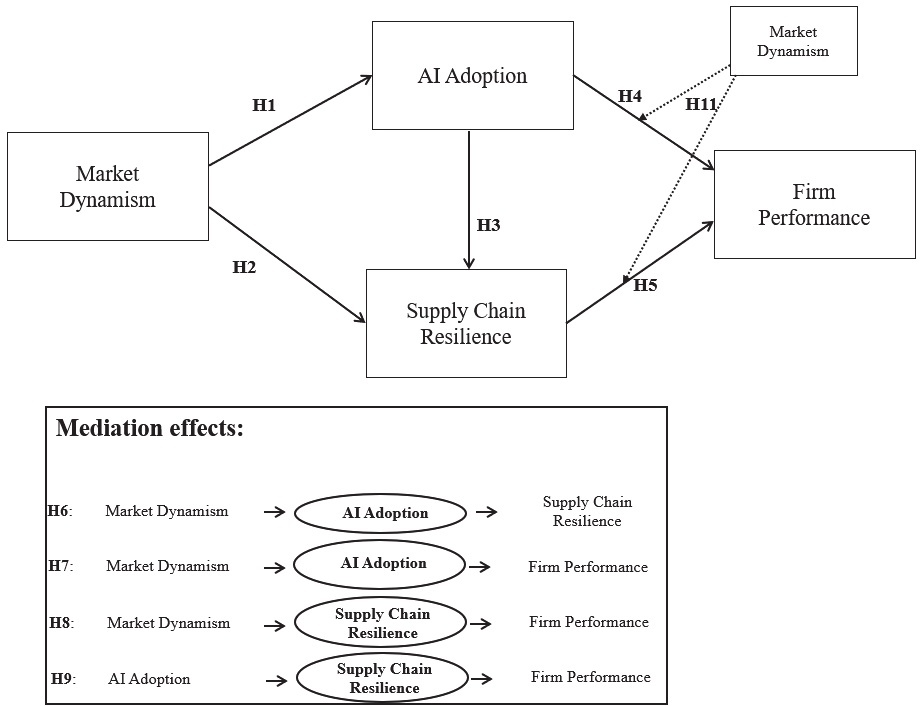
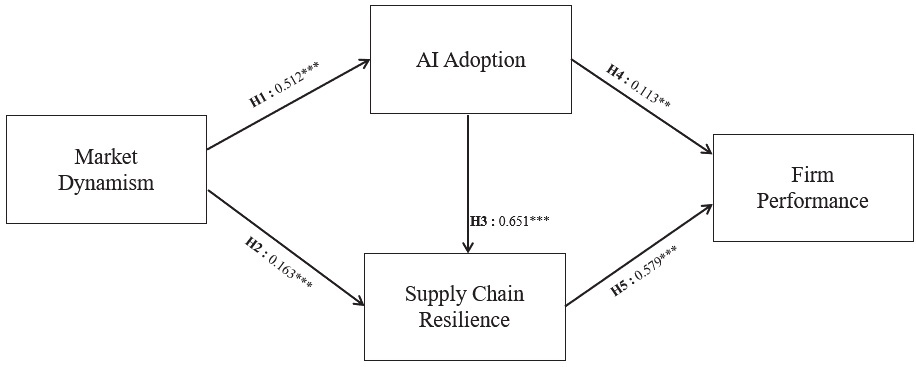
Table 1 Demographics of the Sample
| Variable | Category | Korean Firms | U.S. Firms | Total (%) |
|---|---|---|---|---|
| Number of employees | Less than 149 | 67 | 28 | 95 (32.0) |
| 150–249 | 10 | 52 | 62 (20.8) | |
| Over 250 | 50 | 90 | 140 (47.2) | |
| Firm age | Less than 5 years | 14 | 29 | 43 (14.5) |
| 6–10 years | 18 | 82 | 100 (33.7) | |
| Over 11 years | 95 | 59 | 154 (51.8) | |
| Internationalization (%) | 0–25% | 77 | 42 | 119 (40.0) |
| 26–50% | 19 | 54 | 73 (24.6) | |
| Over 51% | 31 | 74 | 105 (35.4) | |
| Industry type | Manufacturing | 65 | 32 | 97 (32.7) |
| Services / Logistics / Others | 60 | 140 | 200 (67.3) |
Table 2 Operationalization of the Research Instrument
| Variable | Operational definition | Measurement items | Prior research |
|---|---|---|---|
| Market Dynamism (MD) | The degree of rapid and unpredictable changes in customer needs, supplier capabilities, and competitor actions | (MD1) How rapidly do your customers' products or services need to change? (MD2) How rapidly do suppliers' skills and capabilities change? (MD3) How rapidly do competitors change their products or services? | Belhadi et al., 2021; Jaworski & Kohli, 1993 |
| AI Adoption (AA) | The extent to which firms integrate AI technologies into supply chain operations to enhance decision-making, efficiency, and security | (AA1) Our firm uses integrated data analytics to optimize our supplier network. (AA2) Our firm uses AI applications to improve workforce allocation and productivity. (AA3) Our firm uses advanced analytics to optimize resource utilization in our supply chain network. (AA4) Our firm uses AI analytics to enhance cybersecurity and protect data in our operations. | Abou-Foul et al., 2023; Dubey et al., 2020 |
| Supply Chain Resilience | The ability of a firm to anticipate, adapt to, and recover from disruptions through strong, collaborative relationships | (SCR1) Our firm anticipates a long-term partnership with our partners. (SCR2) Our firm feels indebted to our partners for what they have done for us. (SCR3) Our firm has close, personal interactions with partners at multiple organizational levels. (SCR4) Our firm sees the value of maintaining mutual respect with our partners at all levels. | Yu et al. (2019), Altay et al. (2018), and Belhadi et al. (2021) |
| Firm Performance (FP) | The firm's relative success in operational and financial outcomes compared to competitors | (FP1) Our on-time delivery rate is very high. (FP2) We know our customers better than our competition (FP3) Compared to other firms, our sales are better. (FP4) Compared to other firms, our profits are better. | Koufteros et al. (2014); Srinivasan & Swink (2018) |